Examples
Two projects in Quirework’s repository consume it the way yours would: a sample book and a sample site. Both are test fixtures, not showcases. AI wrote them, and no person edited or reviewed their prose, so read them for the structure the tool keeps, not for the writing.
Side Quest
Side Quest is a short comic memoir by Cy Dequest, a documentation engineer who builds Quirework instead of finishing Full Stop, a natural history of punctuation. It is a preface and nine chapters, about seven thousand words, with a spec of what it commits to and a trail of how each commitment got there.
Everything in it is fiction, its author included. Cy Dequest, Cy’s manager, editor and colleagues, and the book Cy never finished do not exist, and none of it is an account of how Quirework was made. An AI played Cy, writing every one of Cy’s messages from a brief, and drove an AI companion that did the work. No person edited or reviewed its prose. So the book demonstrates the method and nothing more: read it for what the tool kept, not for the writing. Its provenance metrics, which measure what the human contributed against what the machine did, measure one model against another.
The problem it is about
The book’s premise is the problem Quirework exists for. The narrator’s unfinished book, a history of punctuation, credited one print shop with a habit in chapter four and a rival shop with the same habit in chapter nine. Fixing either chapter broke the other, and every fix needed a footnote in the other chapter, until the footnotes cited footnotes.
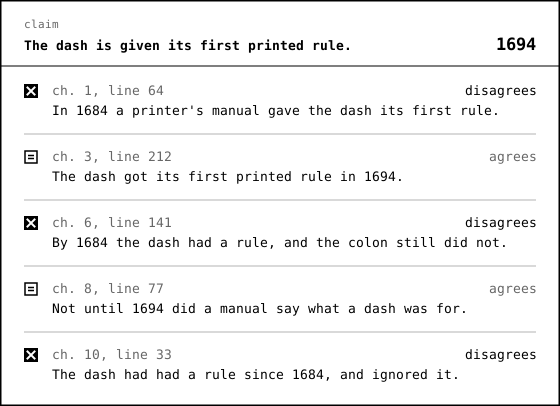
One commitment, followed through the book
One of the book’s commitments says where the tool’s name came from. The invented author first told the story one way, then found a page that proved it wrong, and corrected it. The spec changed, every document that carries the commitment was listed, and an independent review checked the change against all of them.
One spec, four formats, three editions
quirework publish build renders the book to HTML, PDF, EPUB and Word,
then renders each derived edition the same way. Every edition answers to
the same spec. Each edition’s notes bind or omit, with a reason, every
commitment the book makes.
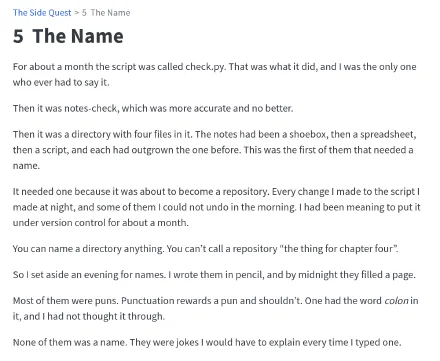
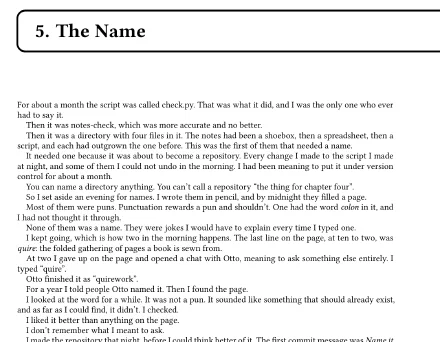
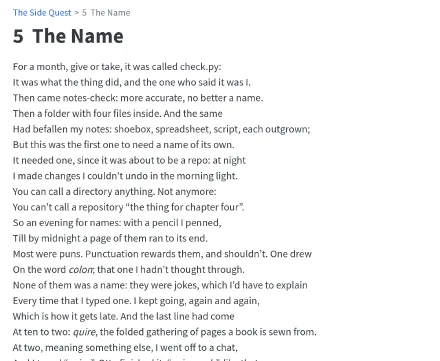
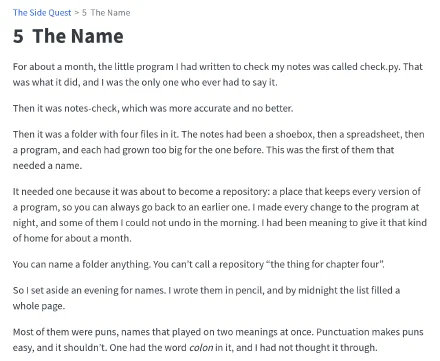
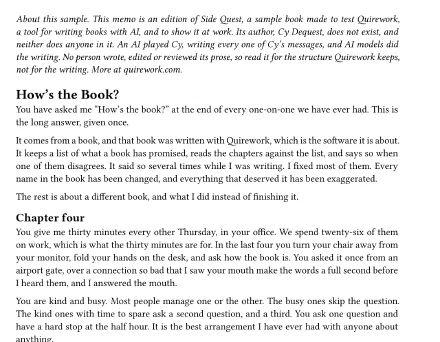
The build checks what goes wrong silently. A figure must have the same number in every format. The EPUB must pass the W3C checker, pinned by version and checksum. A grayscale set of figures is made for e-ink, where color turns to mud. The render refuses to go on in a substituted typeface.
Read it
Each edition is rendered from the book’s source every time this site is
published, by the same quirework publish build an author runs. Every
page carries a notice that the book is a test fixture whose prose no
person reviewed, and every download carries the book’s own note to the
same effect, ahead of the preface.
| Edition | In the browser | Download |
|---|---|---|
| The book | Read the book | PDF, EPUB, Word |
| The poems | Read the poems | PDF, EPUB, Word |
| The young readers’ edition | Read the edition | PDF, EPUB, Word |
| The six-pager | Read the memo |
What to read in it
- The spec,
manuscript/sections/_spec.md, and its trail,provenance/spec-trail.md. - The records of the workshop, room, blind read, roundtable and review
that made parts of it, under
provenance/. - The fifteen sessions it was written in, in
provenance/store. - Its own checks, in
sq_checks/: no em dash anywhere, and two inks in every figure.
Run it from its directory, in the repository:
cd examples/side-quest
quirework spec notes --primer
quirework spec trail the-name
quirework spec notes bind --slug the-name
quirework publish build
The Lighthouse Log
The Lighthouse Log is a small blog built by Hugo: the log of a fictional lighthouse keeper. Like the book, AI wrote it, and no person reviewed its posts. It has two posts in page bundles, one of them a draft. Each post has a spec of its own, with its reader, its thesis and its boundaries. A shared spec holds what both posts lean on, and a post that binds another’s claim is listed when that claim changes.
git ls-files
.claude/skills/lh-write-a-post/SKILL.md
AGENTS.md
CLAUDE.md
README.md
content/posts/_index.md
content/posts/what-the-fog-signal-is-for/index.md
content/posts/why-the-lamp-turns/index.md
hugo.toml
ideas/the-tide-clock/brief.md
procedures/catalog.json
procedures/catalog/README.md
procedures/workflows/write-a-post.md
quirework.toml
quirework/terms.toml
research/copies/coast-pilot.txt
research/sources.md
specs/_site.md
specs/a-keepers-first-winter/spec.md
specs/what-the-fog-signal-is-for/marks.md
specs/what-the-fog-signal-is-for/spec.md
specs/why-the-lamp-turns/marks.md
specs/why-the-lamp-turns/spec.md
hugo.toml and content/. Quirework reads the rest, and the specs and notes sit outside the tree Hugo renders, so no visitor is ever served one. The skill under .claude/ is the entry point sop skills generated.quirework spec units
2031-03-02T09:00:00-03:00 published why-the-lamp-turns Why the Lamp Turns
2031-04-11 draft what-the-fog-signal-is-for What the Fog Signal Is For
planned (a spec, no post yet):
a-keepers-first-winter specs/a-keepers-first-winter/spec.md
ideas (no post has taken them up):
the-tide-clock ideas/the-tide-clock/brief.md
Its voice is checked like its structure. A post with an em dash fails
quirework dev check. quirework text check reports a term from the
project’s list where a reader would meet it, so the term is avoided,
glossed on first use, or kept where it belongs.
The site is in the repository, with a README that lists the commands a companion runs on it.
Why they live in the repository
Each example is documentation and a test at once. The test suite runs their gates on every run, so a change to Quirework that would break a working project fails there, before it reaches anyone’s book or site.
Writing them found the bugs they were written to find: a directory named
docs, a font stack read as a single family, a figure caption that
wrapped across two lines, a nested project collecting the sessions of
the repository around it. Every one passed a reading of the code and
failed the first project that was not the one the code grew up in.